This was an in-person meeting and no video is available.
Our program today was a full one. Our first two speakers, Colleen James and Ayo Owodunni, continued our education on topics related to Black History, Colleen and Ayo were introduced by Madu Kingsley.
Colleen James’ professional career includes more than 15 years of experience in municipal government at both the city and regional levels. As the founder of Divonify Incorporated, Colleen is a leading consultant on equity and inclusion. Locally, nationally, and internationally, Colleen partners with a wide range of public, private, and not-for-profit organizations and businesses that are committed to change.
Colleen graduated from the University of Toronto with an Honours B.A. in history, political science, and Caribbean studies. She holds a master’s degree in leadership, higher, and adult education from U of T’s Ontario Institute for Studies in Education (OISE). In 2020, the Canada International Black Women Event named Colleen one of the Top 100 Black Women to Watch. In 2021, she was named one of the Top 25 Diversity Equity and Inclusion (DEI) Persons of the Year by the Canadian Multicultural Group.
Colleen is a graduate of Leadership Waterloo Region and serves on several local boards and committees, including the Kitchener Public Library (2020-2022), KW Oktoberfest (2020- present) and the selection committee for Leadership Waterloo Region (2019-present). She is also involved in many collaborative community projects, including the Caribbean Canadian Association of Waterloo Region, where she established the James STEM scholarship.
Born and raised in Kitchener, Colleen’s family immigrated to Waterloo Region more than 50 years ago. She currently lives in Kitchener with her partner Daren and daughter Maleigha.
Colleen spoke on Juneteenth and its relation to Canada. Although she is born and raised in KW her family roots include Ethiopia, Nigeria, Barbados’ Antigua, and St. Kitts. Here are some highlights from her presentation.
The Canadian Context
- Documented enslavement is dated back to the 1600s – Oliver Le Jeune
- By the 1790s, approximately:
- 1,200 to 2,000 enslaved Africans lived in the Maritimes (New Brunswick, Nova Scotia and Prince Edward Island).
- Around 300 slaves lived in Lower Canada (Quebec). 700 slaves lived in Upper Canada (Ontario).
- In 1793 the Act to Limit Slavery in Canada was passed, slavery declined in Upper Canada, Lower Canada and the Maritime Provinces.
- It finally ended forever when the British Parliament passed the Slavery Abolition Act in 1834
June 19 – 1865
- In 1863, President Abraham Lincoln issued the Emancipation Proclamation
- which declared a formal end to slavery
- Nearly two and a half years later, on June 19th, 1865, the enslaved African Americans of Galveston, Texas got the news by way of the Union army troops that freedom had come at last.
- Since then, it’s been observed in communities and states as a holiday, but officially recognized as a federal holiday in 2021.
During this two year period many blacks continued to come to Canada via the unground railway.
Black Excellence in Kitchener (Former Berlin)
Queen’s Bush Settlement
- Upon arriving in Canada, many newly freed Blacks settled in what is now Ontario in Amherstburg, Chatham, London, Oro, Woolwich (waterloo region), Wellington and Windsor. Others crossed the Great Lakes to freedom and made their homes in Owen Sound and Toronto
The North America Hotel
- ThePlace where Emancipation Day celebrations would take place – currently across from the CBC radio station building downtown Kitchener.
Mary Ann Shadd (1823-1893)
- Educator, publisher, lawyer, abolitionist
- The Provincial Freeman was an anti-slavery newspaper and it strongly advocated Canada West (Ontario) as a place for Blacks to settle.
Peter E. Susand. - Entrepreneur (1861)
- Barbershop and coffee shop owner
- TheMuseum, is believed to be the location of several businesses
- Escaped enslaved American from New Orleans
Across Canada
The Colored Hockey League of the Maritimes (CHL)
- was an all-Black ice hockey league founded in Nova Scotia in 1895
Lewis Latimer (1848-1928)
- Alexander Graham Bell who hired him to draw the plans for a new invention, the telephone.
Chole Cooley (1759-1831)
- Chloe Cooley was an enslaved woman of African descent living in Queenston, Upper Canada. Her courageous resistance against her violent and forced transportation to New York in 1793 became a well-known example of the everyday acts of resistance of enslaved women of African descent in Upper Canada
Manden Charter 13th Century Sundiata Keita- Mali – The First Declaration of Human Rights
The charter, one of the oldest constitutions in the world, emphasises:
- Social peace in diversity,
- The sanctity of human life,
- Education,
- The integrity of the country,
- Food security,
- The abolition of slave-raiding, freedom of expression and enterprise
- Environmental protection.
The charter gave equal rights to citizens including women and the enslaved. The aim was to provide peace and social stability. It advocated diversity and spoke of abolishing enslavement.
Things to Think About
- Why Black history, Black excellence and Black contributions in Canadian History is scarcely known?
- If we are working towards reconciliation, where does Black Canadian history fit in?
Ayo Owodunni moved to Kitchener with his family from Lagos, Nigeria in 2016. Prior to being elected to Council, he worked as a Consultant, Facilitator, and Learning & Development leader in organizations like Eagles Flight, BPTN, STRIVE! and Farmboy, as well as running his own training and consulting outfit where he helped clients in Nigeria and Kenya build internal leadership capacity and culture. He obtained a Masters in Business Entrepreneurship and Technology (MBET) from the University of Waterloo and a Certificate in Adult Education from George Brown College, Toronto.
During the last few years, Ayo became very active as a community organizer, supporting African associations and community organizations to better meet the needs of immigrants and communities of color. He is the Founder and Co-Host of The Immigrant View, a podcast dedicated to helping new immigrants to Canada move from surviving to thriving, and regularly featured on CityNews 570's The Mike Farwell Show. He also appeared on CBC KW Radio segments offering helpful advice for immigrants and volunteered as a mentor with the YMCA Mentorship Program. The segment was aired in 4 cities across Canada including Kitchener, Montreal, Halifax, and Vancouver. He has served on several Boards including: Leadership Waterloo Region; Adventure4Change; Immigrant Networks; Nigerians in the Region of Waterloo; Coalition of African Associations (now African Canadian Association of Waterloo Region).
As a husband and father of two young children, Ayo is committed to creating a community where families can grow in safety and with a sense of belonging. He loves Ward 5 and is passionate about the issues that matter most to residents, including: safety on our roads and increasing community engagement.
Ayo addressed to topic of Building Inclusive Communities. Ayo is from Nigeria where they have a rich history of oral storytelling, many dealing with animals with an important message or moral and he began his presentation with such a story
A troupe of monkeys were being harassed by a new lion in their area that was killing and eating them at random. They decided to have a meeting with the king and an elder to address the problem. One group of monkeys suggested that they negotiate with the lion and offer to provide the lion with one monkey a week. Another group suggested they leave their land and find a new one. The elder then spoke and suggested that they talk with their cousins the gorillas to see if they could help. The elder indicating that the gorillas were smart and strong and could defend them. Much discussion followed with many of the monkeys saying that they really did not know the gorillas very well, they were strange to them and maybe they could hurt them as well. In the end they decided to negotiate with the lion and offered the elder as the first sacrifice.
The moral of the story is twofold – first: Do not allow fear to hold you hostage, and second: We don’t see the unfamiliar resources available to use.
For Ayo the unfamiliar resources available to us, that we are not taking full advantage of, are the immigrants coming to Canada. We have serious issues with a lack of skilled workers which is going to worsen in the next decade yet we continue to put barriers in their way to gaining meaningful employment in the areas they have skills and training.
These immigrants come to us with three gifts:
A gift if the head – they are educated, have experience and skills
A gift of the hand – they are hardworking and dedicated
A gift of the heart – they have passion, life stories to tell and wisdom
In conclusion Ayo presented six steps to engaging immigrants and building an inclusive community.
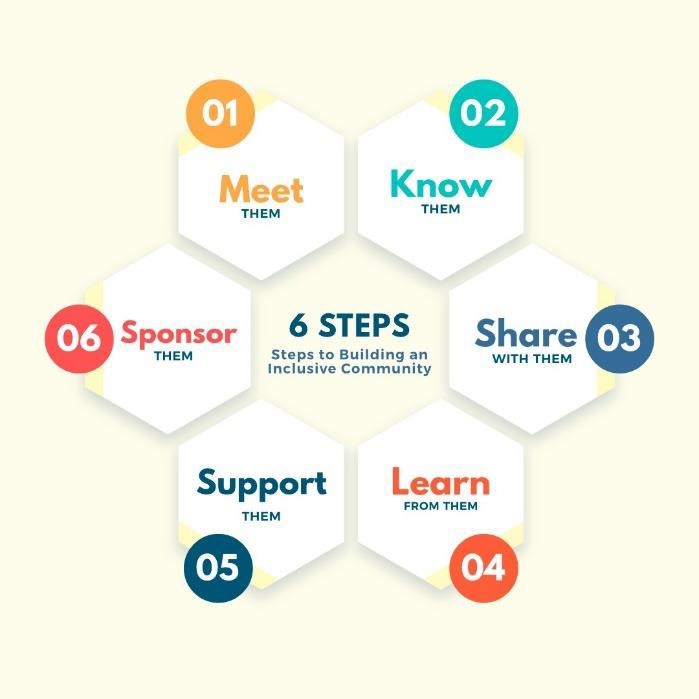 Meet them: Take the initiative to meet immigrants in your community by becoming a mentor or joining local immigrant organizations such as the YMCA, KW Multicultural Center, ACCESS Employment, or Immigration Waterloo Region. You can also offer assistance with English language practice. A small act of support can make a significant impact.
- Get to know them: Foster trust and connections by getting to know immigrants on a personal level. Share your own life story and experiences while being open to learning about theirs. Building connections and trust leads to empathy and a deeper understanding of each other. Take the time to build these connections and truly get to know the individual.
- Share with them: Share resources, learnings, tips, and opportunities with immigrants. What may seem ordinary or routine to you could be completely new and valuable to someone from a different culture. By sharing your knowledge and resources, you can make a meaningful difference in their integration process.
- Learn from them: Recognize and appreciate the wealth of knowledge, education, experience, and exposure that immigrants bring to the table. Be humble and open- minded, willing to learn from their unique experiences and perspectives. By valuing their contributions and actively seeking to learn from them, you show respect and foster a sense of inclusion.
- Support them: Immigrants go through various phases as they integrate into a new community, including euphoria, shock, integration, and thriving. The shock phase can be particularly challenging, and it is during these times that they often need support the most. Be a listening ear, an encourager, and a mentor, providing support and guidance to help them navigate the difficulties they may encounter.
- Sponsor them: Recognize that many immigrants are over mentored but under sponsored. Sometimes, all it takes is opening a door of opportunity to make a significant difference in their lives. Act as a sponsor by making introductions, speaking positively about them behind closed doors, and opening doors that can transform their lives. By advocating for immigrants and actively supporting their goals, you become a catalyst for their success.
Remember, embracing and supporting immigrants is not only beneficial for them, but it also enriches the entire community by fostering diversity, understanding, and collaboration.
We were also pleased to have Betty Anne Keller with us today. She was the producer of the documentary Rock This Town and was deemed the 2022 K-W Oktoberfest’s Rogers Woman of the Year in the Arts and Culture category, She arranged for us to visit the Rock This Town exhibit at the Waterloo Museum but was unable to be with us due to COVID. She provided some additional background information to the exhibit as well as the original documentary and has also provided a link to the documentary. Those wishing to view the full 70 video and access it here; :
https://www.youtube.com/watch?v=R4yiOrhcxxE
Closing Remarks & Reminders