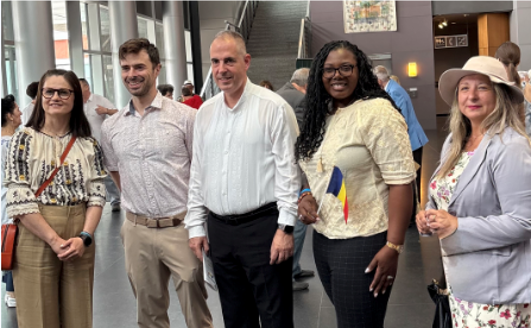
Today’s Meeting was in person and no recording is available.
Our guest speaker today was Jennifer Scott from the house of Friendship, introduced by Secretary Bill.
Our association with the House of Friendship is a strong one. To celebrate our 90th Anniversary in 2012 Kitchener Rotary Donated $90,000 towards the House of Friendship Women’s Addiction Centre Building Campaign, and we had a follow up hands-on project creating the patio at the new centre. We are delighted to have CEO Jennifer with us to continue this relationship.
For over 20 years, Jennifer Scott has worked in the charitable and not for profit sector, with a strong focus on housing, community programs, and organizational leadership. Her career has centered on strengthening services for people experiencing vulnerability and building strong partnerships across the community.
In her role, as the Chief Executive Officer of House of Friendship she provides strategic leadership across housing, addictions, food programs, and community services. She brings a strong systems perspective, deep operational experience, and a steady, people focused approach to leadership. Her work emphasizes service quality, organizational stability, and collaboration across the health and social services system.
Jennifer holds a BA from McMaster University and an MBA from Brock University. She lives in Guelph with her husband and two daughters.
Jennifer spoke about how the House of friendship is innovating and changing the nature of the care and services they are providing, focusing on two key examples. Here are some excerpts from her presentation.
When people talk about homelessness, poverty, addiction, and food and security, the conversation becomes big very quickly. We hear about systems, waitlists, housing costs, and pressures on hospitals, but behind every issue as a person, someone who is trying to navigate their health, trying to feed themselves and maybe other family members as well, or trying to find a safe place to sleep. At the House of Friendship, we have asked ourselves an important question – as the needs around us change, how do we need to change as well? How do we innovate the way in which we provide care in our shelter?
For many years, and for much of the charitable sector, we really have been focused on providing immediate needs – a meal, a place to stay; those things matter as we know, but today people are often carrying several needs all at the same time. A person may need housing, health, addiction support, a trusted person to talk to. The needs are connected and so must be the care of that the House of Friendship provides. This is how the House of friendship has grown and he is growing across housing, addictions, food, community services. We are learning that innovation is not about being flashy. It’s about listening carefully, and noticing where people are falling through the cracks, and having the courage to change when the old way is no longer enough. One of the clearest examples of this is our Selter Care program.
For many years shelter in our community looked much like a dozen other communities; people received a meal and a bed for the night, but during the day they often had to leave searching for other supports. There was no guarantee they would have a bed again the next night. That kind of uncertainty makes it really hard to address the deeper issues that often sit underneath homelessness. It’s hard to focus on your health when you don’t know where you’re going to sleep at night and it’s hard to keep appointments when your whole day is built around survival; so when we were dreaming about the Shelter Care program, we asked a different kind of question – what would happen if shelter became more stable, what would happen if people had access to care providers who knew their name and their story? What would happen if healthcare addiction support and housing support were brought together around the person?
So we opened Shelter Care in 2023. It’s a 24-seven program for men experiencing homelessness where healthcare and shelter exist together. This means as the man in the program can walk down the hallway, he can see someone like Benson, a care coordinator, or, Kaitlyn, an addictions counsellor or, Scrappy, our therapy dog, or, Jenny, the nurse; and this matters because this team is not working on separate things they’re working together with the person at the centre. They’re helping to address the underlying health addiction and housing challenges that brought someone to homelessness in the first place and we’re starting to see some really strong outcomes. More than 40% of the men staying at Shelter Care are accessing some form of addiction treatment, in our previous model this was 0%, and 68% are accessing primary health care within the shelter. We have also seen a 90% EMS diversion rate because of the low barrier access to addiction supports men have when they need it. These numbers tell an important story – men are getting connected to care earlier. They’re getting healthier, and most importantly they’re moving into housing. That is the strength of the Shelter Care program; it brings the care that people need close enough to them and it is steady enough care that they can trust it.
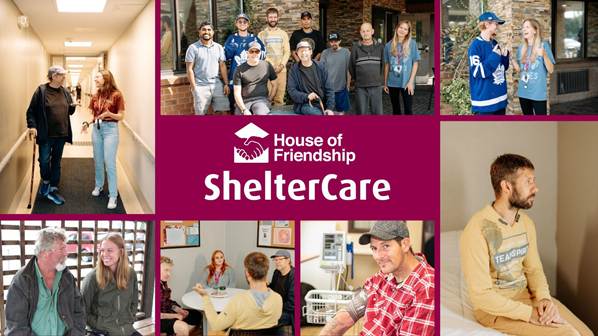
Shelter Care has taught us that having stability in one’s life changes what is possible. When someone has a safe place to rest, meals and care; when someone knows them by name, the conversation shifts from how will I get through tonight to what’s my next step forward? When people have lived in survival mode for a long time moving forward takes more than just one service, or one appointment. It takes coordinated care and it takes relationships.
House of Friendship is taking what we have learned from Shelter Care and is now applying that to Friendship Village, our next project. Friendship Village, our biggest and most ambitious project, is a supportive and affordable housing community being built in two phases in downtown Kitchener. When complete it will provide 170 new units of affordable housing for people exiting homelessness with health integrated support.
This is not just about adding new housing. It’s about creating a community where people can move from homelessness to stability, and then towards greater independence without losing the relationships and support that got them there in the first place.
Through both building design and program design, Friendship Village will offer different levels of care in one connected community. The people that we serve deserve excellent care. They deserve a program and housing that supports their dignity and their health. Friendship Village is that next step towards creating a dignified pathway for people in our community. In \ just another week House of Friendship will be launching Welcome Home Friendship Village, a public campaign, inviting our community to help furnish the final 26 apartments in this supportive housing community. Thanks to our generous community we already have enough support to ensure that most of the units will be furnished, however, we are now inviting the broader community to help ensure that every person who moves into this building will have a fully furnished unit from day one. For someone moving out of homelessness a furnished apartment is more than a collection of items, it’s a fresh start. It’s a place to rest, and it’s a place to heal. This will be Friendship Village.
Enquiries welcome:
Sign up for information:
 Kitchener Rotary e-Newsletter